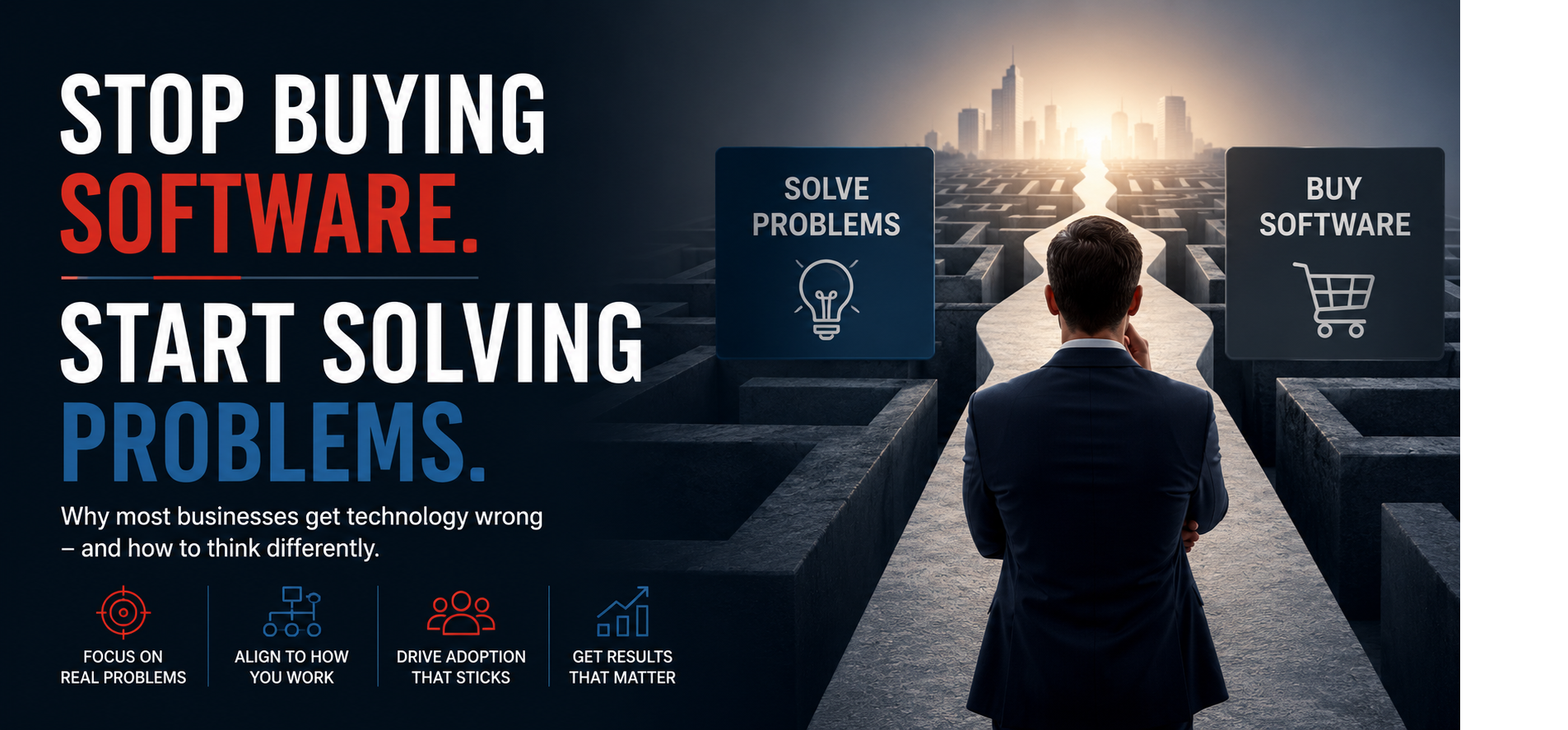

Most businesses don’t fail at choosing software.
They fail at making it work in the real world.
Over the last two decades, I’ve worked with hundreds of businesses adopting technology.
CRMs. ERPs. Marketing tools. Automation platforms.
And yet, I keep seeing the same pattern repeat itself.
A new tool is purchased with excitement. There’s a kickoff. A few training sessions. Some early wins.
And then… slowly, quietly… things start to fall apart.
Usage drops. Teams go back to old habits. The system becomes “optional.”
A year later, the conclusion is simple:
“The software didn’t work for us.”
But here’s the uncomfortable truth:
The software didn’t fail. The problem-solving approach did.
The Real Issue Isn’t Technology
Most businesses don’t have a software problem.
They have:
- A clarity problem
- A process problem
- A adoption problem
Let’s be honest.
When a company decides to “buy a CRM,” what are they actually trying to fix?
- Poor visibility on sales?
- Leads slipping through the cracks?
- No structured follow-ups?
- Dependency on individuals instead of systems?
These are business problems.
But instead of solving them, we jump straight to buying a tool.
Why Software-First Thinking Fails
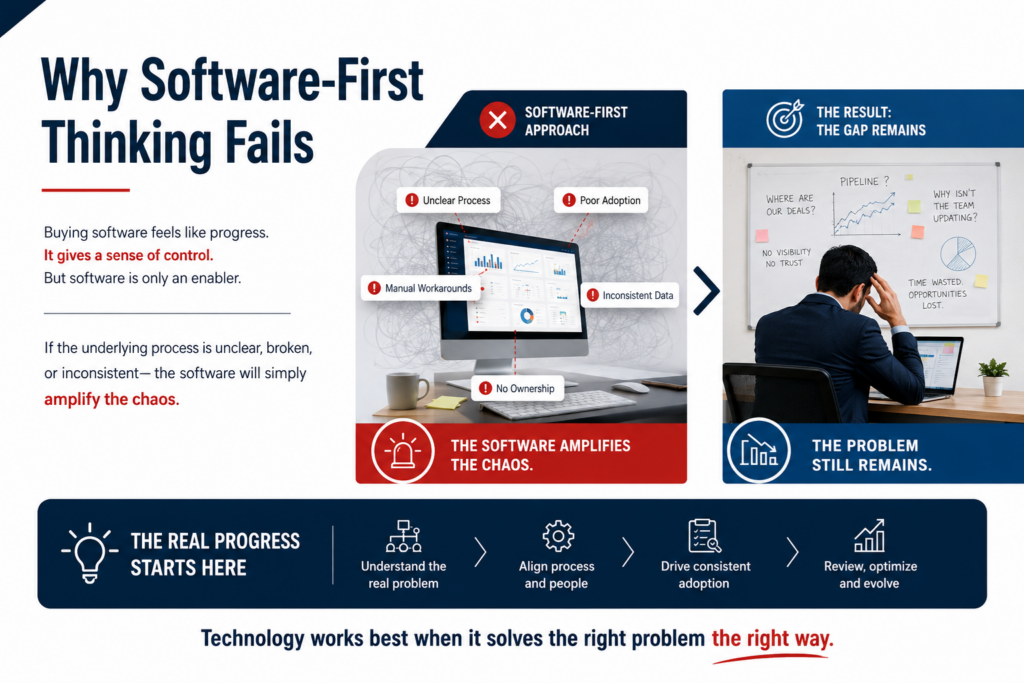
Buying software feels like progress.
It gives a sense of control. A feeling that “we’re doing something about it.”
But software is only an enabler.
If the underlying process is unclear, broken, or inconsistent— the software will simply amplify the chaos.
That’s why you see this:
- CRM filled with incomplete data
- Sales teams working on WhatsApp instead
- Reports that no one trusts
- Founders asking, “What’s the real pipeline?”
The tool exists.
But the problem still remains.
The Month 3 Reality
In most implementations, the real test doesn’t happen on Day 1.
It happens around Month 3.
That’s when:
- Initial excitement fades
- Business pressure increases
- Teams revert to what’s easy
And if the system hasn’t been aligned with how people actually work—
It starts getting ignored.
Not intentionally.
Just gradually.
What Businesses Should Do Instead
Before you buy any software, ask:
1. What exactly are we trying to fix?
Be specific.
Not “we need a CRM.”
But:
- “We are losing 30% of leads due to no follow-up”
- “We don’t have visibility into deal stages”
- “Our sales cycle is inconsistent across reps”
Clarity changes everything.
2. How does our team actually work today?
Not how you want them to work.
But reality:
- Where do conversations happen?
- How do deals move forward?
- What tools are already being used?
If your system doesn’t respect this reality, adoption will fail.
3. What behaviour needs to change?
Technology doesn’t drive change. Behaviour does.
If your team doesn’t:
- Update data consistently
- Follow structured processes
- Trust the system
No software will fix that.
4. Who owns the outcome?
This is where most implementations fail.
There’s no ownership beyond “installation.”
No one is responsible for:
- Adoption
- Optimization
- Alignment with business goals
And without ownership, systems decay.
A Different Way to Think About CRM
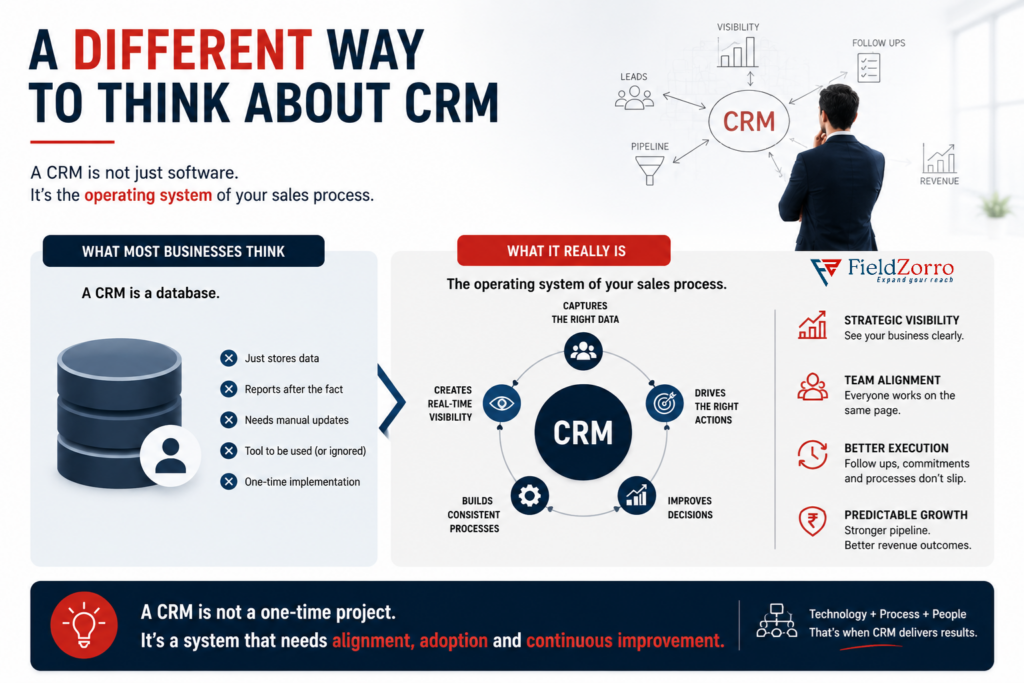
A CRM is not a database.
It’s not a reporting tool.
It’s not a “software purchase.”
It is the operating system of your sales process.
And like any operating system, it needs:
- Continuous alignment
- Regular optimization
- Strategic oversight
Not just setup and training.
Final Thought
If your last CRM “didn’t work,” pause before blaming the tool.
Ask a different question:
Did we solve the problem… or just buy software?
Because most businesses don’t fail at choosing technology.
They fail at:
- Aligning it to real workflows
- Driving consistent usage
- Reviewing and adapting over time
And that’s where the real work begins.
Not on Day 1. But in Month 3… and beyond.
#CRM #CRMAdoption #SMBGrowth #SalesProcess #DigitalTransformation #SalesExecution #ProcessImprovement #BusinessGrowth #ScalingUp